
AI that steps into the real world.
An embedded autonomy platform for humanoid robots, built for inspection, surveillance and hazardous environments.
Two curves are crossing.
For sixty years, giving AI a body remained a fantasy: humanoids were too expensive, AI too fragile. Both barriers are falling at the same time.
- 24 months
- The time it took model reasoning to go from conversational gadget to infrastructure building block.
- ÷ 10
- The cost of a humanoid, in three years. Mass production is coming.
A cognitive OS for humanoids.
The robot receives a mission, reasons about its surroundings, executes, alerts and reports. Everything runs on the onboard computer: no cloud dependency, no data leaving.
The goal: become the cognitive OS of humanoids, whatever the manufacturer.
The platform's five layers, from reasoning to hardware
- Mission engine and model cascadeDeep reasoning and fast reflexes
BRAIN - Navigation and LiDAR mappingAutonomous mapping and movement
NAV - Perception and trackingDetection, tracking, re-identification
PERC - Real-time middlewareStandard robotics bus, Spectre tactical mesh
COMMS - Hardware abstractionPortable from one humanoid to another
ROBOT
2026full pipeline validated in simulation, in May
Code that runs.
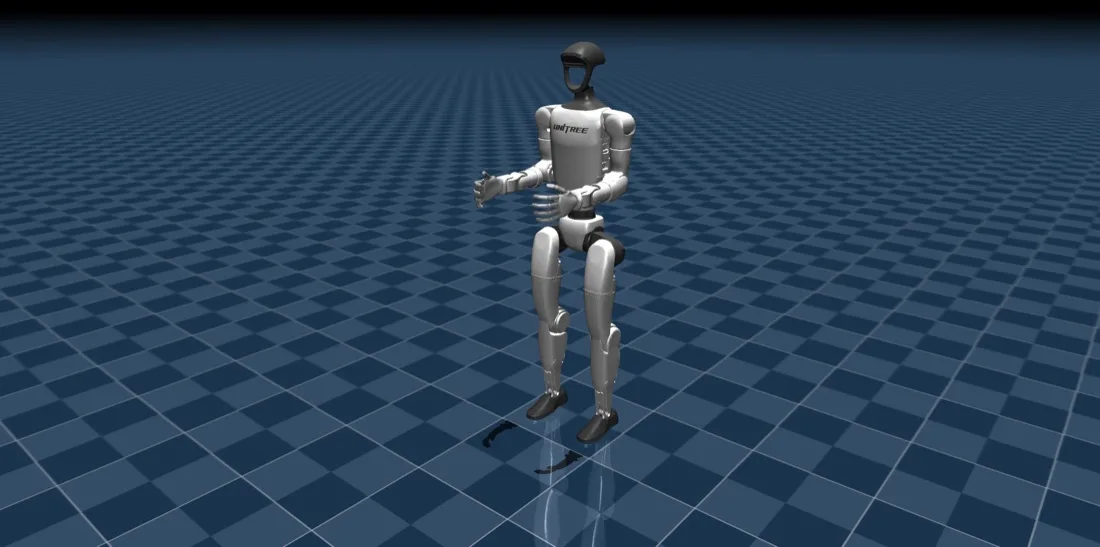
Validated in high-fidelity simulation, the platform receives a mission, plans it, navigates, perceives and delivers its report, end to end and without intervention.
Navigation, mapping and the real-time bus run together in simulation. Next step: the real robot.
Three horizons, one course.
Platform validated in high-fidelity simulation.
Demonstrations on a real humanoid, first industrial-inspection pilots.
Several robots, several manufacturers: fleets operated remotely by AI agents.
A use case in the field?
A programme running at the lab. Industrial inspection, hazardous environments, security: tell us what the robot should do for you.